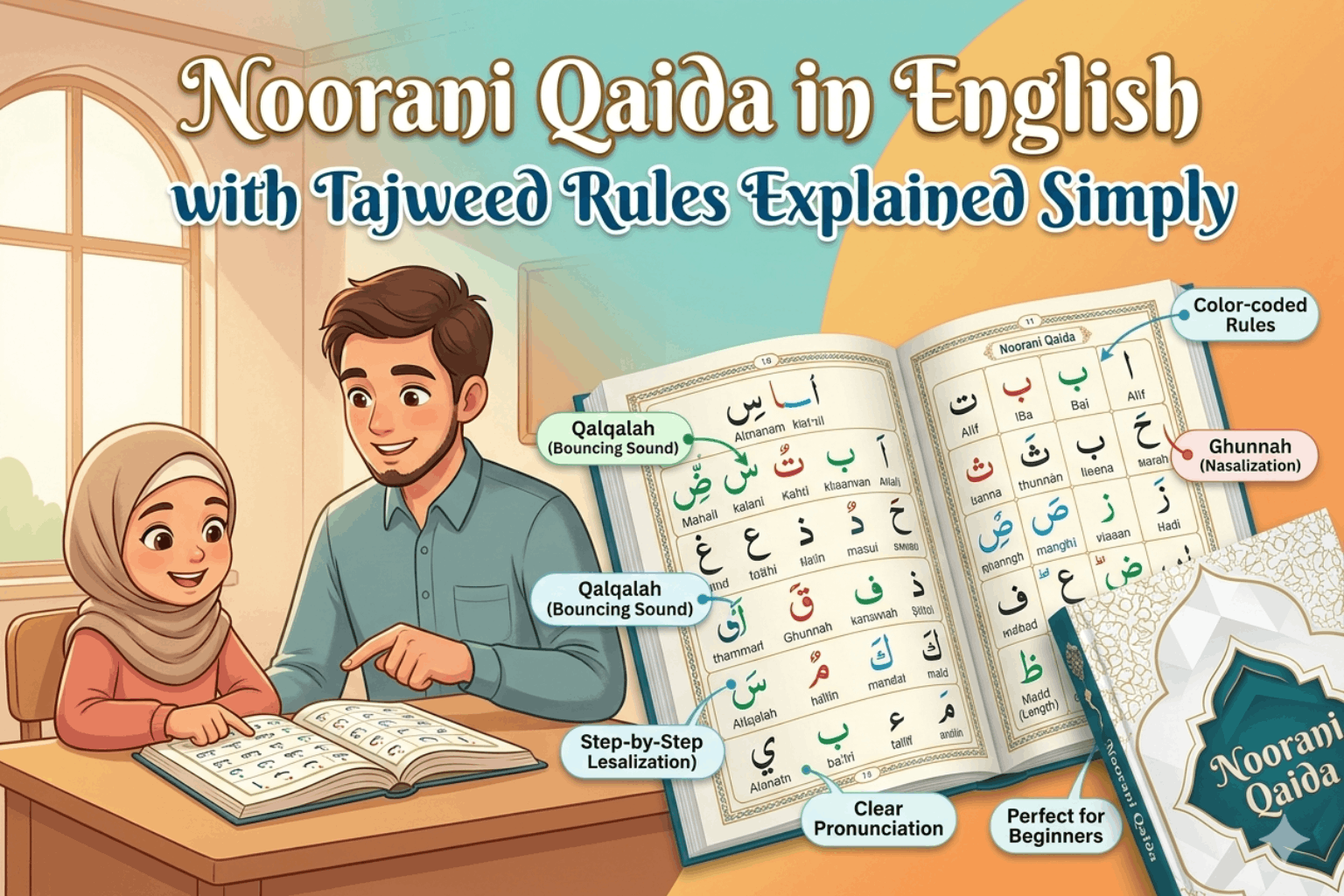
At BayanulQuran Academy, we believe that every Muslim deserves the ability to read the Quran correctly, beautifully, and with confidence. For many beginners, especially those who do not speak Arabic, the journey can feel overwhelming at first. This is where Noorani Qaida in English becomes an essential starting point.
Noorani Qaida is a foundational book designed to teach the Arabic alphabet, pronunciation, and the basic rules of Tajweed. When explained in English, it becomes even more accessible for students across the world who want to learn Quran recitation step by step.
In this guide, we will walk you through Noorani Qaida in English and explain Tajweed rules in a simple and practical way so that you can start applying them from day one.
Table of Contents
What Is Noorani Qaida
Noorani Qaida is a beginner level learning book that introduces Arabic letters, sounds, and pronunciation rules used in the Quran. It is structured in a gradual way, allowing students to move from recognizing letters to forming words and eventually reading full Quranic verses.
At BayanulQuran Academy, we use Noorani Qaida as the first step for all beginners because it builds a strong foundation. Without this foundation, it becomes difficult to recite the Quran correctly.
When Noorani Qaida is taught in English, students understand not just what to read, but also how and why they are reading it in a certain way.
Why Learn Noorani Qaida in English
Many learners today come from non Arabic backgrounds. They may not understand Urdu or Arabic explanations. Noorani Qaida in English solves this problem by making learning clear and accessible.
Here are a few key benefits
- It helps beginners understand pronunciation using familiar language
- It builds confidence in reading Arabic letters
- It allows students to learn Tajweed rules more easily
- It supports self learning as well as guided learning
- It creates a smooth transition towards reading the Quran
At BayanulQuran Academy, we have seen that students who learn Noorani Qaida in English progress faster and make fewer mistakes in pronunciation.
Understanding the Basics of Arabic Letters
The first step in Noorani Qaida is learning the Arabic alphabet. There are 29 letters in Arabic, and each letter has a unique sound.
Unlike English, Arabic letters are pronounced from specific points in the mouth and throat. This is called Makharij, which means the articulation points.
For example,
- Some letters come from the throat
- Some come from the tongue
- Some come from the lips
Learning these sounds correctly is essential because even a small mistake can change the meaning of a word in the Quran.
At BayanulQuran Academy, we focus on helping students pronounce each letter clearly before moving forward.
Joining Letters to Form Words
Once students are comfortable with individual letters, the next step is to join them to form words.
Arabic letters change their shape depending on their position in a word. They can appear at the beginning, middle, or end.
Noorani Qaida teaches this step by step so that students do not feel overwhelmed.
For example,
- Letters connect smoothly to form readable words
- Some letters do not connect on one side
- Practice helps improve fluency
This stage is important because it prepares students to read actual Quranic text.
Introduction to Harakat
Harakat are the small symbols placed above or below letters to indicate short vowel sounds.
There are three main Harakat:
- Fatha which produces a short a sound
- Kasra which produces a short i sound
- Damma which produces a short u sound
These marks are essential because they guide pronunciation. Without them, beginners would not know how to read words correctly.
In Noorani Qaida in English, these symbols are explained clearly so that learners can understand and apply them easily.
Sukoon and Its Role
Sukoon is a symbol that shows a letter has no vowel sound. It means the letter is read in a calm and stopped manner.
This concept is simple but very important in Tajweed.
For example,
- It helps in stopping correctly on letters
- It ensures proper flow in recitation
- It prevents incorrect pronunciation
Students at BayanulQuran Academy practice Sukoon repeatedly until it becomes natural in their reading.
Shaddah and Double Letters
Shaddah is a symbol that indicates a letter should be pronounced with emphasis or doubled. This means the sound of the letter is stronger and held slightly longer.
Understanding Shaddah is important because it affects the meaning and rhythm of Quran recitation.
For example,
A single letter and a doubled letter can change the meaning.
It adds beauty and clarity to recitation
In Noorani Qaida in English, this rule is explained in a simple way so that learners can recognize and apply it confidently.
Madd or Elongation
Madd means stretching or prolonging a vowel sound.
There are different types of Madd, but beginners start with the basic concept of holding a sound for a few counts.
For example
- Some letters are stretched for two counts
- Others may be stretched longer depending on the rule
Madd adds rhythm and beauty to Quran recitation. Without it, the recitation sounds incomplete.
At BayanulQuran Academy, we teach students how to count and control their breath while applying Madd.
Basic Tajweed Rules Explained Simply
Tajweed means to recite the Quran correctly by giving each letter its due right.
Here are some basic Tajweed rules explained in a simple way
Noon Saakin and Tanween
These rules apply when a noon sound appears without a vowel or with double vowels.
Depending on the letter that follows, the sound may change.
For example
- Sometimes the sound is clear
- Sometimes it is hidden
- Sometimes it is merged
Learning these variations helps improve fluency and correctness.
Meem Saakin
This rule applies when the letter Meem has Sukoon.
It can be pronounced in different ways depending on the next letter.
For example,
- Clear pronunciation
- Slight merging
- Nasal sound
These variations are taught step by step in Noorani Qaida.
Qalqalah
Qalqalah is a bouncing sound that occurs in certain letters when they have Sukoon.
It creates a slight echo effect.
This rule is easy to learn but requires practice to perfect.
Ghunnah or Nasal Sound
Ghunnah is a nasal sound that comes from the nose.
It is used in specific letters and rules.
This sound adds a unique beauty to Quran recitation and must be practiced carefully.
How Noorani Qaida Builds Tajweed Skills
One of the biggest advantages of Noorani Qaida is that it introduces Tajweed gradually.
Instead of overwhelming students with complex rules, it teaches them step by step.
At BayanulQuran Academy, we follow a structured approach
- Start with letters and sounds
- Move to word formation
- Introduce basic Tajweed rules
- Practice with examples
- Build fluency through repetition
This method ensures that students not only learn but also retain what they have learned.
Common Mistakes Beginners Make
Many students make similar mistakes when learning Noorani Qaida
- Rushing through lessons without mastering basics
- Ignoring proper pronunciation
- Not practicing regularly
- Confusing similar sounding letters
- Skipping Tajweed rules
At BayanulQuran Academy, we focus on correcting these mistakes early so that students build a strong foundation.
Tips to Learn Noorani Qaida Effectively
Here are some practical tips to help you learn Noorani Qaida in English
- Practice daily even if for a short time
- Focus on pronunciation more than speed
- Listen to expert reciters
- Repeat lessons until you are confident
- Learn with a qualified teacher if possible
Consistency is the key to success in Quran learning.
Transition from Noorani Qaida to Quran Reading
Once you complete Noorani Qaida, you are ready to start reading the Quran.
The transition becomes much easier because
- You already know the letters
- You understand vowel sounds
- You are familiar with Tajweed basics
At BayanulQuran Academy, we guide students from Noorani Qaida to Quran reading smoothly so that they continue their journey with confidence.
Why Choose BayanulQuran Academy
At BayanulQuran Academy, we are committed to making Quran learning simple, effective, and accessible for everyone.
Here is what makes our approach unique
- Experienced and qualified teachers
- One on one online classes
- Structured Noorani Qaida curriculum in English
- Focus on Tajweed and pronunciation
- Flexible timings for students worldwide
We understand that every student learns at a different pace, and we tailor our teaching accordingly.
Final Thoughts
Learning Noorani Qaida in English is the first and most important step in your Quran journey. It builds the foundation for correct pronunciation, understanding Tajweed, and reading the Quran with confidence.
With the right guidance, consistent practice, and a clear understanding of the basics, anyone can learn to recite the Quran beautifully.
At BayanulQuran Academy, we are here to support you at every step of this journey. Whether you are a complete beginner or someone looking to improve your recitation, Noorani Qaida in English with simple Tajweed explanations can open the door to a lifelong connection with the Quran.